 Velara
Birth chart guide
Your birth chart, explained.
A birth chart is a map of the sky at the exact minute and place you were born. Here's how to read one — and why the time on your birth certificate matters more than you think.
What it is
One moment, frozen in the sky.
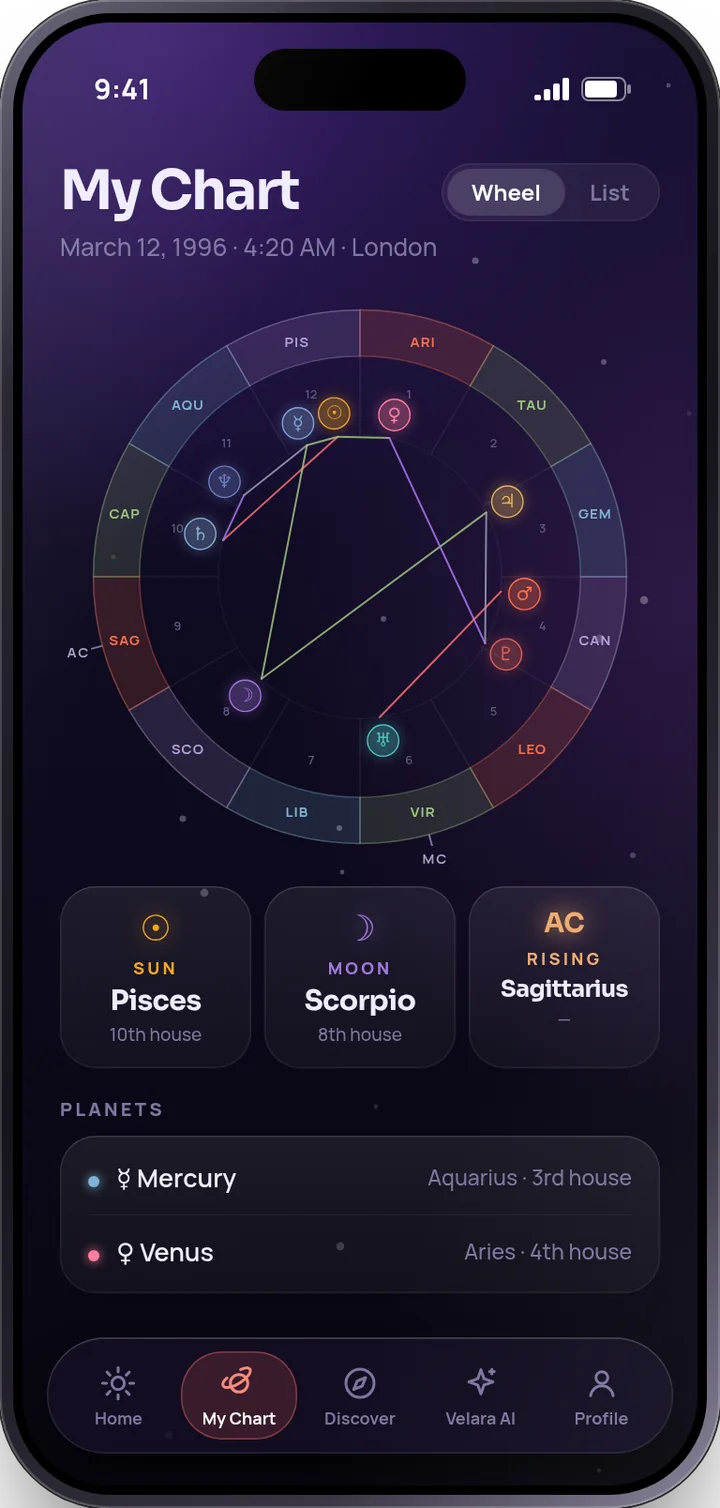
Picture the sky at the moment you were born, seen from the place you were born. Every planet was somewhere along the band of the zodiac; one sign was rising on the eastern horizon; the whole sky was divided into twelve houses. A birth chart — also called a natal chart — is that moment drawn as a wheel.
Astrologers read it in three layers: planets (what is acting), signs (how it acts) and houses (where in life it shows up). The angles between planets — the aspects — show how those parts of you get along.
To calculate it you need three things: your date, your place and your time of birth. The time matters because the sky turns: on average a new sign rises over the horizon about every two hours, and the Moon changes sign about every 2.3 days.
The Big Three
The Big Three: Sun, Moon, Rising.
Your Sun sign comes from your birthday. Your Moon and Rising signs need the full date, time and place — and they change far faster.
Sun — your core self and identity. Changes sign about once a month.
Moon — your emotions and inner needs. Changes sign about every 2.3 days.
Rising — how you meet the world. Changes about every two hours on average.
The planets
Ten voices in one chart.
In astrology the Sun and Moon count as “planets” too. Each one stands for a different part of you; its sign shows its style.
Sun
Identity, vitality and what you are here to become.
Moon
Emotions, instincts and what makes you feel safe.
Mercury
How you think, learn and communicate.
Venus
Love, pleasure, taste and what you value.
Mars
Drive, desire and how you go after things.
Jupiter
Growth, luck, faith and where life expands.
Saturn
Structure, discipline and the lessons that take time.
Uranus
Change, independence and sudden insight.
Neptune
Dreams, imagination and the things you can't pin down.
Pluto
Power, depth and transformation.
The houses
Twelve rooms of a life.
The houses divide your chart into twelve areas of life, starting from your Rising sign. They depend on your exact birth time and place.
First house
Self, appearance and first impressions
Second house
Money, possessions and self-worth
Third house
Communication, siblings, learning and short trips
Fourth house
Home, family, roots and private life
Fifth house
Creativity, romance, pleasure and children
Sixth house
Work, daily routines, health and service
Seventh house
Partnerships, marriage and contracts
Eighth house
Shared resources, intimacy and transformation
Ninth house
Philosophy, higher learning and long journeys
Tenth house
Career, reputation and public life
Eleventh house
Friends, groups, hopes and community
Twelfth house
The subconscious, solitude and what's hidden
Aspects
How your planets talk to each other.
An aspect is a meaningful angle between two planets. These five are the major ones; how much leeway (“orb”) each gets varies by astrologer.
| Aspect | Angle | Meaning |
|---|---|---|
| Conjunction | 0° | Blending — two planets act as one. |
| Sextile | 60° | Opportunity — an easy opening, if you take it. |
| Square | 90° | Tension — friction that pushes you to act. |
| Trine | 120° | Harmony — talents that flow naturally. |
| Opposition | 180° | Polarity — learning to balance two sides. |
Tropical vs. sidereal
Two zodiacs, one sky.
Western astrology uses the tropical zodiac: 0° Aries is always the March equinox, so the signs stay in step with the seasons. Vedic astrology uses the sidereal zodiac, which lines the signs up with the fixed stars.
The two lined up about 2,000 years ago. Precession has since moved them about 24° apart, which is why many people's sidereal Sun sign is one sign earlier than their tropical one. Velara calculates your natal chart in the tropical zodiac, and its Vedic reading in the sidereal one.
Curious what each sign means? Explore all twelve zodiac signs, or read how Velara calculates your chart.
FAQ
Birth charts, quickly
What do I need to calculate my birth chart?
Your date of birth, the place you were born and, ideally, your exact birth time. The time decides your Rising sign and your houses; your birth certificate or a family record is the best source.
What if I don't know my birth time?
You can still see where every planet was and which sign it was in. What you can't get reliably is the Rising sign and the houses — and if the Moon changed sign that day, your Moon sign may be uncertain too. What to do if you don't know your birth time.
Is a birth chart the same as a horoscope?
Originally, yes — “horoscope” meant the chart itself. Today it usually means a short forecast for a Sun sign. Your birth chart is the personal map those forecasts are a simplified version of.
What's the difference between tropical and sidereal?
The tropical zodiac, used in Western astrology, ties 0° Aries to the March equinox, so the signs follow the seasons. The sidereal zodiac, used in Vedic astrology, aligns the signs with the fixed stars. Because of precession the two now sit about 24° apart, so many people's sidereal Sun sign is one sign earlier.
Get your chart in two minutes.
Velara calculates every planet, house and aspect for the minute you were born — free.
Free to start — birth chart, daily scores and a daily tarot card included.